The Major League Baseball Playoffs are not realistic, and destroy the actual meaning of the sport.
Major League Baseball is unique in this respect—its postseason is markedly different from the way the game is played normally. No other major league sport suffers from this flaw.
Not that much is wrong with baseball. In some respects it's the most well thought-out sport there is. The "perfect game" many aficionados  say.
say.
But the Major League Baseball postseason experience is unique in the world of professional sports, and not in a good way.
In fact the playoffs are flawed in such a way as to detract from the sport itself and diminish the game and what it means to be the world champion of the sport.
Among the Big Four team sports of North America: football, hockey, basketball and baseball—and all the 122 professional major league teams competing in the NFL, NHL, NBA and MLB respectively—it is in baseball alone that the postseason turns the sport itself on its head and makes it reflect something that it is not. This article will explain why that happens and why it is wrong-headed.
Background on the The Frequency of Play
The 30 teams in both the National Hockey League and the National Basketball Association teams play a very similar schedule. On average, each team has a day off between games, sometimes two days off. Though there are back-to-back games, they are relatively infrequent. NBA teams play between 14 and 22 back-to-back games a season, and for the NHL it usually ranges between 9 and 19. The NFL has a full week between games, the exception being the new Thursday games that each team plays once, leaving them only four days' rest once a year.
But baseball players play every single day. Ten days straight, then a day off, then seven more games, then a day off, then ten more games. Typically a baseball team plays 27 games every 30 days. For the NHL and NBA it would be 14 per month, and for the NFL the number would be 4.
Getting to the Playoffs: It's a grind
In all four sports, getting to the postseason requires a total team effort—in fact an all-out total organizational effort. Teams must be deep, have bench strength and the capability of moving players in and out of the lineup, and on and off the roster, who can take the place of key players who go down for an injury, or who have to miss games for whatever reason. While this is true of the other three major sports as well, it is most certainly even more of a concern for baseball teams because of the sheer volume of games in which a team must field a competitive lineup.
Each league's regular season* is a marathon, not a sprint. NFL teams play for 17 weeks, 16 games. The NHL has an 82-game season over six months, paralleled by an NBA season of 84 games over the same timeframe. Baseball is the biggest marathon of all—a true test of resilience and endurance—162 games usually starting around the beginning of April and finishing about the end of September.
NHL teams carry 23-man rosters, of which 20 can be active for any particular game. The NBA is similar, with 15-man rosters of which 13 can be on the bench for a given game. In the NFL, the teams have 53 players on a roster, but only 46 can suit up on game day. In Major League Baseball, teams have a 25-man active roster, and all 25 are at the park every day.
The Postseason Playoffs: Sport by Sport
The National Football League:
Of the 32 teams, 12 qualify for the playoffs. The playoffs are conducted in the exact same manner as the regular season. Each team plays once a week, the exception being that the four top teams get the first week off. For a typical qualifier to reach the Super Bowl, the team must play three consecutive weeks. At that point both remaining teams have two weeks off before the Super Bowl.
In short, the playoffs, with a game each week, reflects the same means of advancement as is present in regular season grind.
 The National Hockey League:
16 of the 30 teams qualify for the postseason. The playoffs are conducted in the exact same manner as the regular season: a game, a day off, a game, a day off, a game, a day off, and so on. Just as in the regular season, there are occasionally two days off. But the playoffs require the same stamina, the same approach as that required to make the playoffs.
The National Basketball Association
16 of the 30 teams qualify for the postseason. The playoffs are conducted in the exact same manner as the regular season: a game, a day off, a game, a day off, a game, a day off, and so on. Just as in the regular season, there are occasionally two days off. But the playoffs require the same stamina, the same approach as that required to make the playoffs.
 Major League Baseball
10 of the 30 teams qualify for the postseason. (Although four of those teams qualify only for a one-game do-or-die play-in game.)
Here is where all similarity to baseball ends.
Unlike the other three sports whose playoffs mirror the test of the regular season, and whose conditions are the same as the regular season, Major League Baseball playoffs in no way resemble the sport itself. In hockey, basketball and football, the teams win playoff games and reach the pinacle of the sport in exactly the same way that they qualify to try to do so.
Not so in baseball. They are two entirely different concepts. Teams make the playoffs only because they have depth, five-man pitching rotations and can play day-in and day-out at a high level. But the baseball playoffs suddenly become a kind of "all-star" game within each team's roster. MLB playoffs are conducted in a way that more closely follows the NBA and the NHL. Teams have enormous numbers of days off.
Here's the key point: No Major League Baseball team could even qualify for the postseason if they played the same way during the regular season that they do in the playoffs. None.
In the regular season Major League Baseball teams have to use a 5-man starting rotation, with pitchers pitching every 5th day. There are not enough days off to have even a four-man rotation, let alone a team with three pitchers. Even the best team in baseball using only a 4-man rotation, would wear them out, and most likely end up with a record of something like 66-96, or 70-92—and that would be if they were otherwise teh best team in the sport.
 The 2014 Baseball Postseason is Typical
As examples, last year's World Series teams the Kansas City Royals played only 15 games in 30 days, and the San Francisco Giants played only 17 games in 30 days. The 12 to 15 days off in the non-baseball fantasy world of the MLB postseason, means that teams can turn to three pitchers and give all of them plenty of rest. But it isn't the way baseball really works.
At one point, the Royals had 5 consecutive days off, and the Giants had 4. This never happens in the regular season. Even the All-Star break is only three days. Very rarely is there anything beyond a one-day break, and even that happens only a couple of times a month.
What this means is that neither team used the team that got them to the playoffs. (The NFL, NBA and NHL teams ALL used the very same teams that got them to the playoffs.)
Baseball teams use a three-man pitching rotation in the playoffs. Sometimes, they essentially opt for two pitchers only—conceding the likelihood that some of their games are going to be lost—when their third-, or rarely fourth-best pitcher has to face one of their opponents' two-man or three-man rotation members.
Imagine an NFL team using only one running back and three wide receivers, instead of rotating through their roster in the course of a playoff game—or using only 4 defensive backs and 4 linebackers, instead of rotating 8 or 9 DBs and 6 or 7 linebackers? In hockey, would a team use only two or three of their forward lines? Would an NBA team use only the starting five? They would never make the post season if they tried to present that product to their fans during the regular season.
Those are the equivalents of what Major League Baseball sets up every fall. No other sport drags its playoffs out in such a way as to completely change the playing field—completely change the dynamics of its game.
Why Does Baseball Do This?
MLB does this because the TV networks want to drag out the games so that they can try to have one game each day This requires an unnecessary staggering of games, and creates the phenomenon of 15 off-days in a month.
What about travel days?
What about them? Baseball has travel days constantly. A team may play in Chicago one day and in Miami the next, or in New York one day and Phoenix the very next day. Travel days as a routine part of the game are again, a phenomenon of television, and stretching out the playoffs.
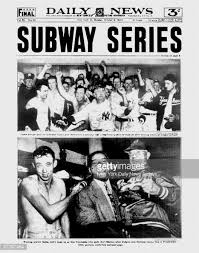 In years past, travel days were employed only when necessary. The famous "subway series" games were played on seven consecutive days. Why? Because there was no "travel day" required to go from Brooklyn to the Bronx. Today, they would put in artificial travel days.
Even fairly long train trips didn't necessarily matter. The 1948 World Series between the Cleveland Indians and the Boston Braves was played in six consecutive days, October 6 & 7 in Boston, October 8, 9 & 10 in Cleveland, and October 11 back in Boston.
This reflects actual baseball, the way the teams play day-in and day-out, and the kind of unique test that baseball presents to its athletes, its managers and management, and to its fans.
In the modern world of charter planes, teams fly from coast to coast to play games on consecutive days. The artificial "travel day" should be eliminated so that teams can play in the playoffs in the same way that got them there in the first place.
*All these leagues also have pre-seasons and training camps, which add an additional 6-8 weeks to each player's year.
Email us with your feedback, comments, questions and ideas.