New Mexico Political Journal
mobile icon
New Mexico Political Journal

.

Show Subnavigation
  • Home
  • About NMPJ
    • About
    • Editor
  • Feedback
  • Advertise on NMPJ

FacebookTwitter

If you read New Mexico Political Journal from a Facebook link, and appreciate the coverage of events, please “like” NMPJ on Facebook.

EXPOSÉ, Part 2: Governor Martinez Furious with Ryan Cangiolosi. Cangiolosi took UNM job to Lobby for the Hospital while working for the Governor. Ethics Questions Abound. For Yates it was the Case of the Disappointed Office Seeker. Governor Sees Both as Sources of Discontent and Disunity.

09/12/2017

THE RYAN CANGIOLOSI and HARVEY YATES SHENANIGANS 

Last week we exposed the motives behind a bitter blogger's attacks on Governor Martinez and on the University of New Mexico regents, its administration, its basketball program.

Suspiciously, though they were referred to obliquely, blogger Daniel Libit left off specific references to Republican State Party Chairman Ryan Cangiolosi and Republican National Committeeman Harvey Yates.  This led most readers to conclude that Cangiolosi and Yates were again the primary sources of the discontent, backbiting, rich gossip — most often unattributed — that Libit decided to go to press with.

 

RYAN CANGIOLOSI: RELISHING THE ROLES OF HORSE HOLDER and "SOURCE"

Ryan Cangiolosi worked on Susana Martinez's campaign and was given a comfortable position within the Martinez Administration, as is customary in politics everywhere. But insiders report he was incredibly dismayed when he was not given the chief of staff position. That was apparently laughable to those who understood Cangiolosi’s qualifications and talents:

“This is a guy who was a church music director and an errand-boy for Harvey Yates. No one seriously considered him qualified to be chief of staff.”  

And the latter fact was clear — he was always the horse holder for General Yates, and his loyalty was to him, not to New Mexico and certainly not to Martinez.

Cangiolosi fell out with the administration because of the shady way in which he landed his UNMHSC Gig.

Ryan developed a reputation even within Republican circles for being what one Administration member described as a "mealy-mouthed panderer who constantly tried to ascertain which way the political winds were blowing and then cast himself as being on that side." Those in the office would mock Cangiolosi’s frequent name-dropping line of:

“Oh, he (insert name of perceived elite being discussed) is a good friend of mine.” 

But while he was quick to name-drop, he was very slow to take strong positions.

So it was out of character somewhat when Cangiolosi suddenly began to aggressively push for the expansion of the UNM hospital. Though no one had any inkling of what lay ahead.

Cangiolosi suddenly began arranging meetings with members of the Board of Finance and UNM hospital executives in his office on the 4th floor. People found that curious, given Cangiolosi’s history of never leading the charge on anything.

Unbenownst to those on the 4th floor and to the Governor herself, there was a very logical — if incredibly conflicted — reason why Cangiolosi was lobbying so hard for the new hospital.  

Then the other shoe dropped. 

CANGIOLOSI WAS LOBBYING FOR HIS FUTURE EMPLOYER

It turned out that Cangiolosi had already accepted a position at UNM Health Sciences and was merely fulfilling that role while simultaneously continuing to serve on the governor's staff. Despite this obvious conflict, he never disclosed this fact to the Governor or those on the 4th floor — just as he was taking such an interest in pushing for the hospital. 

The Governor and others were disgusted by his actions. To make matters worse, Cangiolosi attempted to explain his new position by stating he was going to be “special projects director.”

According to one inside source:

"Cangiolosi literally stated that one responsibility would be, 'You know, like they have different keys for doors and those all need to use the same key.' "

This was seen as almost hilarious. If you don't think about the ethics. Everyone rolled their eyes, immediately understanding precisely what Cangiolosi’s real job was going to be — lobbying the administration, in direct violation of the Governor’s executive order against former administration officials lobbying the administration within 2 years of leaving their posts.   

As another staff member put it: 

 "It was clear to everyone — everyone perhaps except Cangiolosi — that he had been given a completely fake position and that his actual role was to be somehow on the inside lobbying the administration for UNMH."

GOVERNOR MARTINEZ INCENSED with the CANGIOLOSI MANEUVERS

The Governor, who campaigned against Richardson-era corruption, was furious at both Cangiolosi and UNM for what everyone recognized was a shady attempt to grease the skids for the hospital, and other projects.

Sad. But that's the way politicos in New Mexico keep doing things. Governor Martinez has taken great strides to reduce this sort of behavior, but as we can all see, it hasn't been wiped out.

UNM had not figured out something very simple: The best way to deal with Martinez is straight-up. Just present your case, and answer any and all questions that may arise. Instead, they tried a Richardson Era shortcut, thinking that hiring Cangiolosi (or some other perceived "insider") would get them to their goal — even as they refused to answer questions.

Big mistake.

INADVERTENT POINT MADE BY DANIEL LIBIT RE: GOV MARTINEZ

In his hit piece last week, Daniel Libit inadvertently confirmed a key Martinez characteristic: After writing about the friendship between the governor and Coach Neal, it's noteworthy (especially in light of Libit's spin — and that of Eaves) that Martinez didn't do anything to prevent Neal's firing. This points up the fact that she's never been one to let personal relationships affect how she approaches public business.

CANGIOLOSI RESPONDS WITH A VENGEANCE

Cangiolosi, after finding himself — perhaps unexpectedly on his part — on the outs with Martinez, turned to attacking Republicans. This was very consistent with his mentor Yates, and was seen by most to be an expected natural outgrowth of all he had done leading up to that point.

In 2016, Cangiolosi and Yates convinced many Republican legislators to abandon the governor’s political operation in favor of one run by them and Doug Turner, a consultant with somewhat limited success in winning races.

Cangiolosi and Yates were successful in wresting control of the legislative races away from Martinez.

The result was a disaster: Republicans lost control of the House in the 2016 elections. Something it had taken 60 years to win back was lost in the self-serving machinations. As far as anyone could tell, Yates and Cangiolosi were happy with the outcome — after all, their goal was merely to be in positions of "leadership" within the party.

But for many rank and file Republicans going back to what could be another 60-year wait was very frustrating. Meanwhile in the same election, Martinez was successful in defeating Senator Michael Sanchez, the powerful and extremely obstructionist Democratic leader of the Senate.

[EDITOR'S NOTE: Also in 2016, Martinez was the chair of the Republican Governor's Association (RGA). It was an incredibly dumb moment for Yates and Cangiolosi to foist their movida on legislators and other candidates and push to marginalize the governor, but that's what they did. The RGA finished the cycle with the most Republican governors in US history. This contrasts incredibly with the failed NM House campaigns of Yates and Cangiolosi.]

This year, Cangiolosi and Yates have further marginalized Martinez and are running the show in the Albuquerque mayor’s race. Their candidate — Dan Lewis — appears to be floundering at around 7% in the polls. 


VENGEANCE and DIVISION: Is it all that Cangiolosi and Yates Think About?

And it wasn't just fellow Republicans and Republican candidates that Cangiolosi and Yates took aim at. Years later, in November of 2015, Cangiolosi accidentally outed himself as the source of an article that created a firestorm in the press.  It was that the FBI was completing an investigation of Martinez political advisor Jay McCleskey (an investigation that found no wrongdoing, incidentally).
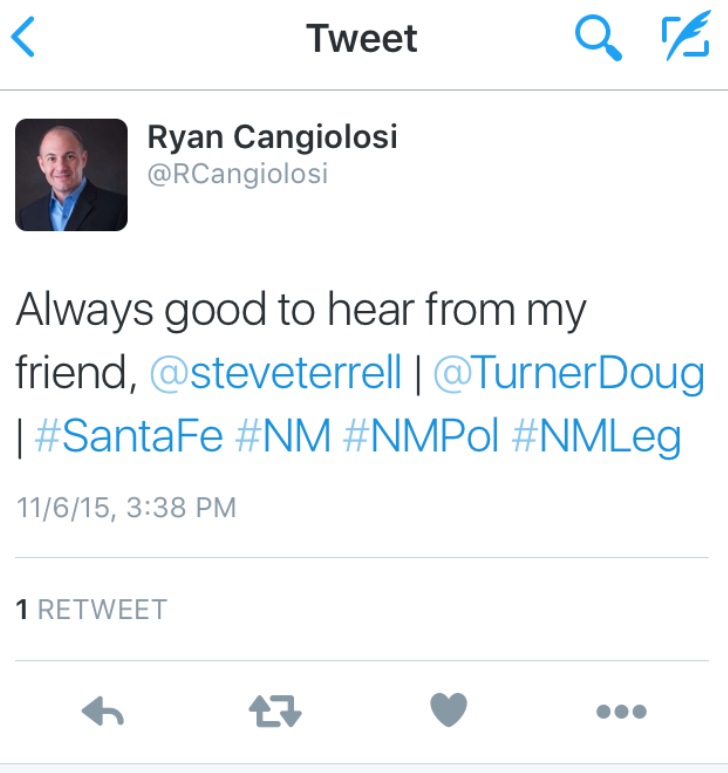
Foolishly, Cangiolosi tweeted that he had just spoken to Santa Fe New Mexican reporter Steve Terrell, who later that evening broke a story using a single unnamed “prominent Republican” source.

Cangiolosi must have figured out that he had just exposed himself with the tweet, because minutes after the article broke Cangiolosi tried to delete it. Unfortunately for Cangiolosi, it was already captured.  

The Yates Saga
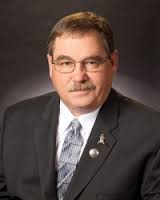
Harvey Yates is on record throughout the state sowing discontent and launching attacks on fellow Republicans. "Hurricane Harvey" as he is increasingly known, lets everyone who will listen know — immediately — how much he disapproves of Martinez's "performance," though there is much evidence to suggest his disapproval is based on other "criteria."

And he wistfully recounts his memories of former Senator Tim Jennings, the Democrat who Yates long worshipped as his idea of an economic wizard who almost single-handedly ran the state. Having that particular Democrat — and a few others also — lose to a Republican (of all people) would bring about political and economic catastrophe according to Yates.

$450,000 was spent to get Yates' point across. 12,000 glossy mailers went out with Yates stem-winding endorsement. Full-page ads were purchased with the Yates imprimatur — all to keep a conservative Republican from having the seat that Yates thought Jennings must have for life.

Chaves and Eddy County voters listened. Ignored Yates completely. And sent Jennings packing in a landslide loss, ending 34 years of apparent euphoria for Yates.

Martinez's Big Sin?

As we have documented before, Harvey Yates had carved out a huge role for himself in the new Martinez Administration. He believed she "may not have some of the necessities" (to quote former LA Dodgers GM Al Campanis)  to take on the actual job of governor and needed his personal guidance.

When Yates was subsequently passed over for the job of Transition Chair in favor of Heather Wilson, someone Martinez saw as having vastly more public policy knowhow and insight, Yates was perturbed beyond anything imagined.

Unbeknownst to anyone other than the itching ears he sought out, Yates' denigration of Martinez began early — and without any warning. Within a couple of years, certain people began parroting various Yatesisms about how "Susana" is this or that, failing in some vaguely unspecified way.

In short, Yates is the classic definition of the "disappointed office seeker" — the exact description used to describe the man who cut President Garfield's term somewhat short. Fortunately Harvey doesn't go to that extreme. Nonetheless, backbiting and personal agendas take their toll on people, on reputations, and in terms of party unity.

Yates is a poster child of disunity in New Mexico, and he flocks with two or three others whose only "agenda" is not the public good, but instead their own intensely personal one.

THE BOTTOM LINE: When Group B Republicans Win, Republicans Lose

We have discussed the phenomenon of the "Group B" Republicans in New Mexico — those whose main goal is the pursuit of what they regard as "power and influence." ("Group A" Republicans on the other hand, are focused on winning races against Democrats and trying to gain majorities in the legislature.)

The story of New Mexico politics in this case could be a tragic one. In January of 2015, Republicans had control of the Governor’s office, the state House for the first time in 60 years, and the Albuquerque Mayor’s office for the first time in a quarter century. Cangiolosi and Yates have already given back the state House.

Next month, we’ll find out how successful they are in Albuquerque. 

And in 2018, we’ll see if they can hold the Governor’s office. If Republicans fail to recapture the House, and fail to hold the mayor’s office and the governorship, Yates and Cangiolosi will again have no one to blame but themselves. (But to be fair it isn't the top priority of Group B Republicans to accomplish these things, so if they're still in "leadership" they'll probably not feel there's any problem at all.)


Email us (at nmpj@dfn.com) with your feedback, comments, questions and ideas.


Intelligent Political Discourse—for the Thoughtful New Mexican

back to list
National Issues

National Issues

Democrats

2016 Presidential Campaign - Democrats

Republicans

2016 Presidential Campaign - Republicans

Jeb Bush gets religion.

"They said he got religion at the end, and I'm glad that he did."  — Tom T. Hall. The Year Clayton Delaney died.

Well, it's official.  Jeb Bush has changed quite of few of his positions on illegal immigration.  The single most significant is that he no longer endorses the "path to citizenship" for those who came here illegally. 

This is, after all, the key portion of any proposal aimed at "reforming" our existing illegal immigration situation.

No sensible citizen can see any point in trying to deport between 12 and 16 million people currently living in America illegally.  And no candidate for any office that we know of supports that.  What the average American wants is for the country to "get a handle on it."  They want it stopped, our borders secured and future illegal immigration prevented.  It is a national security issue.

The Path to Legal Status

The only way to accomplish the above goals, is to identify current illegal immigrants, get them accounted for, have them documented, and placed on a path to legal status.  Neither they nor their children or spouses should live in a state of fear or anxiety.

But a path to "citizenship" is not the right course.  It is not morally or legally correct.  A merciful and compassionate nation can provide the safeguards of legal status without sending the message to the rest of the world that all you have to do is cross our border and you will eventually get to become a citizen, thus circumventing the legal framework scores of millions of Americans have followed, honored and respected.

If someone who is granted legal status eventually wants to become a citizen, that person should have to return to his or her country of origin and wait in line like 20 million people around the world are doing at any given time.  Failing that, America will forever send the signal that anyone in the world can "jump the line," and that there is no reason at all to obey our immigration and naturalization laws.

We Like Jeb Bush

We are glad Jeb Bush has learned this lesson.  He is a fine speaker, and can eloquently explain his positions on complex issue.  If he were not named "Bush" he would be an actual top tier candidate—in all that that title would entail, including likelihood of acceptance and support of and from the American people in the primaries, and in any theoretical general election.  

We also recognize that he already is a de facto top-tier candidate because of his fame and his fundraising.

If he were to be the nominee of the Republican Party we would heartily support him and endorse him.  We hope, however, that he is not, as he does not give the center-right coalition the best chance of winning.

Media Watch

Media Watch

County Government News

County Government News

Cities, Towns and Villages

Cities, Towns and Villages

Judicial Watch

Judicial Watch

Movies, Television, Pop Culture

Movies, Television, Pop Culture

  • Movies, Television, Pop Culture
    Selma   ????? We have now seen the Oscar-nominated movie Selma.   Our earlier allusion to criticism that sounded as though it was in an Oliver Stone category for historical fabrication is some...

Sports

Sports

The Major League Baseball Playoffs are not realistic, and destroy the actual meaning of the sport. 

Major League Baseball is unique in this respect—its postseason is markedly different from the way the game is played normally.  No other major league sport suffers from this flaw.

Not that much is wrong with baseball. In some respects it's the most well thought-out sport there is.  The "perfect game" many aficionados say.

But the Major League Baseball postseason experience is unique in the world of professional sports, and not in a good way. 

In fact the playoffs are flawed in such a way as to detract from the sport itself and diminish the game and what it means to be the world champion of the sport. 

Among the Big Four team sports of North America: football, hockey, basketball and baseball—and all the 122 professional major league teams competing in the NFL, NHL, NBA and MLB respectively—it is in baseball alone that the postseason turns the sport itself on its head and makes it reflect something that it is not.  This article will explain why that happens and why it is wrong-headed.


Background on the The Frequency of Play

The 30 teams in both the National Hockey League and the National Basketball Association teams play a very similar schedule.  On average, each team has a day off between games, sometimes two days off.  Though there are back-to-back games, they are relatively infrequent.  NBA teams play between 14 and 22 back-to-back games a season, and for the NHL it usually ranges between 9 and 19. The NFL has a full week between games, the exception being the new Thursday games that each team plays once, leaving them only four days' rest once a year.

But baseball players play every single day.  Ten days straight, then a day off, then seven more games, then a day off, then ten more games.  Typically a baseball team plays 27 games every 30 days.  For the NHL and NBA it would be 14 per month, and for the NFL the number would be 4.


Getting to the Playoffs:  It's a grind

In all four sports, getting to the postseason requires a total team effort—in fact an all-out total organizational effort.  Teams must be deep, have bench strength and the capability of moving players in and out of the lineup, and on and off the roster, who can take the place of key players who go down for an injury, or who have to miss games for whatever reason.  While this is true of the other three major sports as well, it is most certainly even more of a concern for baseball teams because of the sheer volume of games in which a team must field a competitive lineup.

Each league's regular season* is a marathon, not a sprint.  NFL teams play for 17 weeks, 16 games.  The NHL has an 82-game season over six months, paralleled by an NBA season of 84 games over the same timeframe. Baseball is the biggest marathon of all—a true test of resilience and endurance—162 games usually starting around the beginning of April and finishing about the end of September.

NHL teams carry 23-man rosters, of which 20 can be active for any particular game.  The NBA is similar, with 15-man rosters of which 13 can be on the bench for a given game. In the NFL, the teams have 53 players on a roster, but only 46 can suit up on game day.  In Major League Baseball, teams have a 25-man active roster, and all 25 are at the park every day.


The Postseason Playoffs:  Sport by Sport

The National Football League:

Of the 32 teams, 12 qualify for the playoffs.  The playoffs are conducted in the exact same manner as the regular season.  Each team plays once a week, the exception being that the four top teams get the first week off.  For a typical qualifier to reach the Super Bowl, the team must play three consecutive weeks.  At that point both remaining teams have two weeks off before the Super Bowl.

In short, the playoffs, with a game each week, reflects the same means of advancement as is present in regular season grind.

The National Hockey League: 

16 of the 30 teams qualify for the postseason.  The playoffs are conducted in the exact same manner as the regular season: a game, a day off, a game, a day off, a game, a day off, and so on.  Just as in the regular season, there are occasionally two days off.  But the playoffs require the same stamina, the same approach as that required to make the playoffs.


The National Basketball Association

16 of the 30 teams qualify for the postseason.  The playoffs are conducted in the exact same manner as the regular season: a game, a day off, a game, a day off, a game, a day off, and so on.  Just as in the regular season, there are occasionally two days off.  But the playoffs require the same stamina, the same approach as that required to make the playoffs.

Major League Baseball

10 of the 30 teams qualify for the postseason.  (Although four of those teams qualify only for a one-game do-or-die play-in game.)

Here is where all similarity to baseball ends. 

Unlike the other three sports whose playoffs mirror the test of the regular season, and whose conditions are the same as the regular season, Major League Baseball playoffs in no way resemble the sport itself.  In hockey, basketball and football, the teams win playoff games and reach the pinacle of the sport in exactly the same way that they qualify to try to do so. 

Not so in baseball.  They are two entirely different concepts.  Teams make the playoffs only because they have depth, five-man pitching rotations and can play day-in and day-out at a high level.  But the baseball playoffs suddenly become a kind of "all-star" game within each team's roster.  MLB playoffs are conducted in a way that more closely follows the NBA and the NHL.  Teams have enormous numbers of days off. 

Here's the key point:  No Major League Baseball team could even qualify for the postseason if they played the same way during the regular season that they do in the playoffs.  None.

In the regular season Major League Baseball teams have to use a 5-man starting rotation, with pitchers pitching every 5th day.  There are not enough days off to have even a four-man rotation, let alone a team with three pitchers.  Even the best team in baseball using only a 4-man rotation, would wear them out, and most likely end up with a record of something like 66-96, or 70-92—and that would be if they were otherwise teh best team in the sport.


The 2014 Baseball Postseason is Typical

As examples, last year's World Series teams the Kansas City Royals played only 15 games in 30 days, and the San Francisco Giants played only 17 games in 30 days.  The 12 to 15 days off in the non-baseball fantasy world of the MLB postseason, means that teams can turn to three pitchers and give all of them plenty of rest.  But it isn't the way baseball really works.

At one point, the Royals had 5 consecutive days off, and the Giants had 4.  This never happens in the regular season.  Even the All-Star break is only three days.  Very rarely is there anything beyond a one-day break, and even that happens only a couple of times a month. 

What this means is that neither team used the team that got them to the playoffs.  (The NFL, NBA and NHL teams ALL used the very same teams that got them to the playoffs.) 

Baseball teams use a three-man pitching rotation in the playoffs.  Sometimes, they essentially opt for two pitchers only—conceding the likelihood that some of their games are going to be lost—when their third-, or rarely fourth-best pitcher has to face one of their opponents' two-man or three-man rotation members. 

Imagine an NFL team using only one running back and three wide receivers, instead of rotating through their roster in the course of a playoff game—or using only 4 defensive backs and 4 linebackers, instead of rotating 8 or 9 DBs and 6 or 7 linebackers?  In hockey, would a team use only two or three of their forward lines?  Would an NBA team use only the starting five?  They would never make the post season if they tried to present that product to their fans during the regular season.

Those are the equivalents of what Major League Baseball sets up every fall.  No other sport drags its playoffs out in such a way as to completely change the playing field—completely change the dynamics of its game.

Why Does Baseball Do This?

MLB does this because the TV networks want to drag out the games so that they can try to have one game each day  This requires an unnecessary staggering of games, and creates the phenomenon of 15 off-days in a month.

What about travel days?

What about them?  Baseball has travel days constantly.  A team may play in Chicago one day and in Miami the next, or in New York one day and Phoenix the very next day.  Travel days as a routine part of the game are again, a phenomenon of television, and stretching out the playoffs.

In years past, travel days were employed only when necessary. The famous "subway series" games were played on seven consecutive days.  Why?  Because there was no "travel day" required to go from Brooklyn to the Bronx.  Today, they would put in artificial travel days.

Even fairly long train trips didn't necessarily matter.  The 1948 World Series between the Cleveland Indians and the Boston Braves was played in six consecutive days, October 6 & 7 in Boston, October 8, 9 & 10 in Cleveland, and October 11 back in Boston.

This reflects actual baseball, the way the teams play day-in and day-out, and the kind of unique test that baseball presents to its athletes, its managers and management, and to its fans.

In the modern world of charter planes, teams fly from coast to coast to play games on consecutive days.  The artificial "travel day" should be eliminated so that teams can play in the playoffs in the same way that got them there in the first place.


*All these leagues also have pre-seasons and training camps, which add an additional 6-8 weeks to each player's year.


Email us with your feedback, comments, questions and ideas. 

Religious Issues

Religious Issues

  • Religious Issues
    Coming Soon

Copyright New Mexico Political Journal 2015
EMAIL US WITH YOUR FEEDBACK, COMMENTS, QUESTIONS AND IDEAS

.

Loading...